
Two reasons why you should not be afraid of making decisions
What to do when your manager tells you to “be more decisive”

The Intentional Manager is for the corporate professional who is tired of surface-level advice — each issue works to understand the why behind strategy, leadership and execution, from first principles.

“The only piece of feedback my boss gave me in the past three years is that I need to be more decisive,” MM told me last week.
Yes, this is terrible feedback, neither specific nor actionable. Yes, a manager who provides feedback only during the performance review cycle is doing a poor job. These will be topics for future articles though.
Instead, the purpose here is to show you, MM, that making more decisions independently is easy once you overcome the two big fears.
Overcoming the fear of overstepping
For years you have played a specific role and you believe that stepping up could come across wrongly, as if you wanted to steal from your boss’ plate.
I understand where you are coming from and yet, in ten years of corporate life, I have never heard a manager complain that his people were too independent. Not even once. For all practical purposes, the risk of overstepping is zero.
Likely case, your manager will thank you; unlikely case, he will tell you to run some of those decisions by him; in any case, you will be better off than you are today.
And you will land much further than you would have thought possible.
The pushback
“But I have already tried and he jumps in and corrects me every time!”
Then you need to have a conversation.
You need to understand why it is that he jumps in - mistrust in your judgment, desire to be helpful, instinct, need for control, habit - and disclose how you feel about it. Then share with him that you are trying to be more independent and obtain his “permission” to keep doing so.
I firmly believe that, once you have this conversation, he will be very happy to let you have more space and to see you take on more decisions and, thus, more responsibility.
Overcoming the fear of being wrong
Nobody likes being wrong and the more decisions you make and the more wrong you will be - it’s just how things are.
And yet, here’s a secret: most decisions don’t matter.
Out of the hundred things you do and out of the hundred decisions you make every day, only the tiniest fraction actually moves the needle. Of course, this does not mean “make decisions at random and quit working because your job is pointless,” but it does mean that you can be more relaxed because, if the decision doesn’t matter, making a mistake doesn’t matter either.
If still not convinced, think of decisions as if living in a 2x2 space:
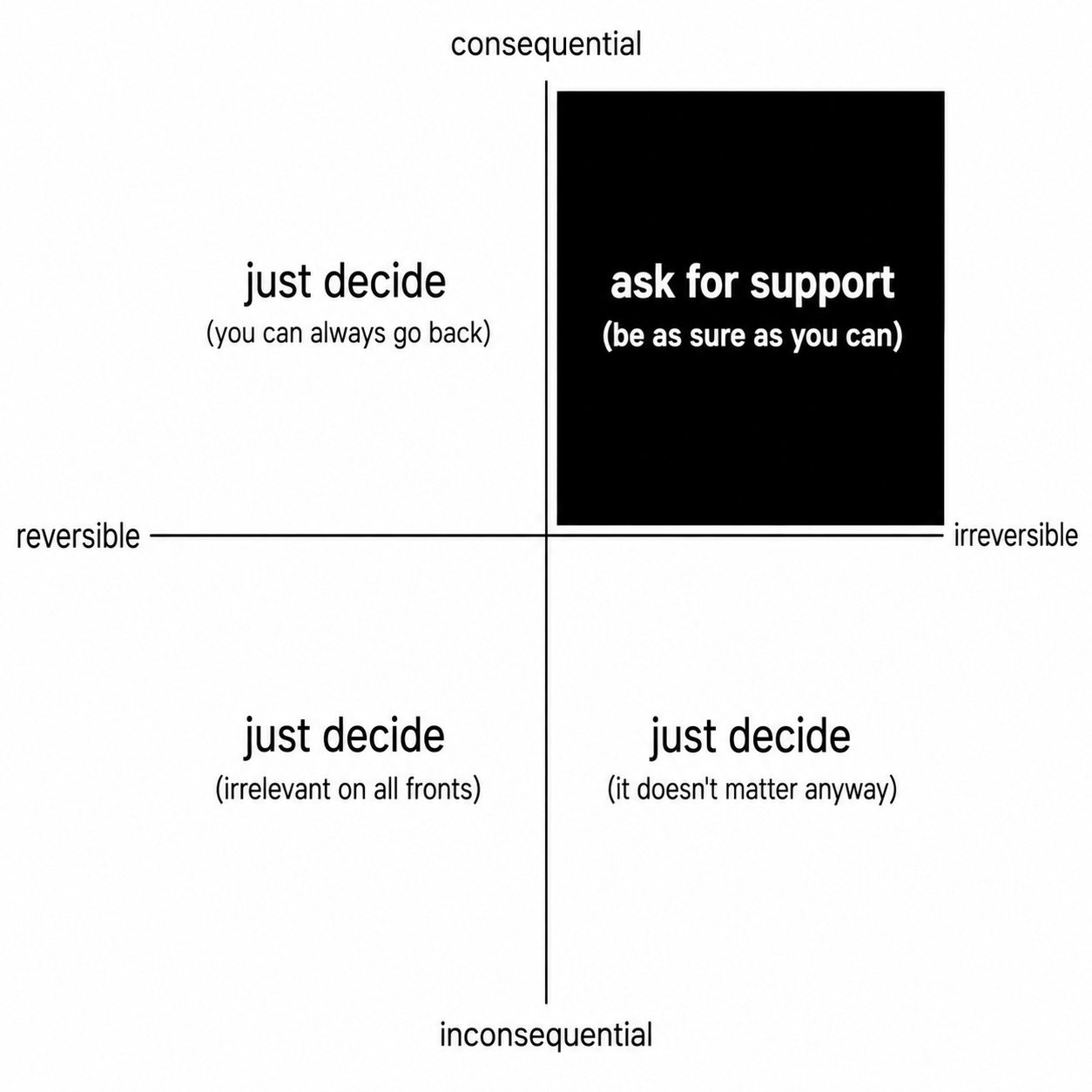
Spend time and ask for support on the decisions that are consequential AND irreversible. Here you want to be right and 97% sure before pulling the trigger.
Everything else, either because reversible or inconsequential or both, is irrelevant: once you are 60% sure, jump.
A real life example
Imagine that your boss is relying on you to organize a congress: when should you seek his input?
Here’s how I would use the matrix.
Consequential and irreversible - ask for input:
When to organize the congress, irreversible because the dates are hard to change once set and consequential because a mistake might mean fewer participants and a lower return on the investment.
The topic of the lunch symposium, consequential because the right topic might unlock new deals and irreversible because you need to support it before the congress with a marketing campaign, which costs time and money.
The chosen speakers, consequential because they give credibility to the whole congress and irreversible because you can’t retract the invitation once you have extended it.
Irreversible but inconsequential - decide on your own because they don’t matter:
The hotel you book for the team, irreversible because it is hard to change once booked, inconsequential because nobody really cares.
Whether you have organized a transfer from the airport for the customers, irreversible because you can’t organize it on the very day, but inconsequential because they can just grab a taxi.
The graphics of the leaflet, irreversible because you would need to re-print everything, but inconsequential because customers will only glance at them anyway.
Consequential but reversible - decide on your own because you can always go back and change:
The messages to pass during the company-led session, consequential because they advance the commercial agenda, but reversible because you control all speakers and can change at the last moment.
The phrasing of the questions you’ll be asked during the survey, consequential because the phrasing shapes the data you gather, but very easy to change.
Inconsequential and irreversible - decide on your own because irrelevant on all fronts:
What gadget to provide to customers.
Whether to have a cake celebrating a specific milestone or not.
How to arrange the products on the table.
MM, there you have it!
As long as you keep in mind that your boss wants you to make more decisions and that most of them don’t matter anyway, you will do just fine.
I look forward to hearing how the next performance conversation goes.
Thanks for reading,
Luca
If someone in your network would find this useful, forward it their way - it costs you little and might just make their Monday morning slightly less painful.
Wisdom and some great observations here my friend.
Great call out. As a manager I can tell you I prefer a proactive person who makes mistakes I can help them see afterwards rather than somebody who’s not acting unless explicitly directed.
Funny enough more senior individuals have shown the latter behaviour more often than the less experienced ones.