
5 steps to craft the perfect useless meeting
Why have a productive meeting when you could waste everyone’s time instead?

The Intentional Manager is for the corporate professional who is tired of surface-level advice — each issue works to understand the why behind strategy, leadership and execution, from first principles.
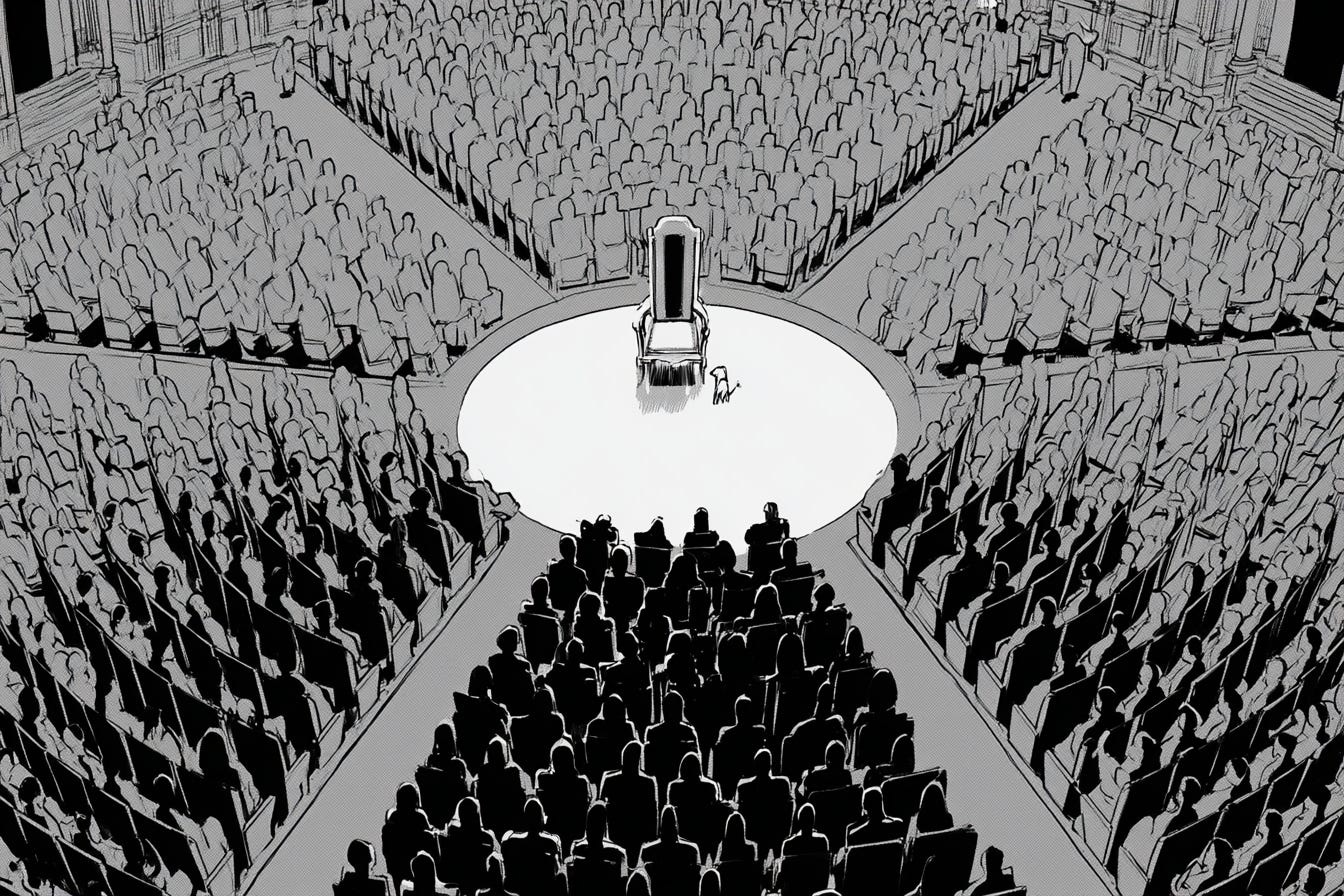
The Employee fired up his laptop and stared at the screen.
It was an anonymous morning and yet it was not like all the others: for today, he needed to make a Very Important Decision.
This Very Important Decision concerned the Very Important Project that he had been working on for the last few months.
It was a cross-functional project of international scope, which was the thing that made it Very Important. It was so Important that the scope was not clear, as often these big projects spiraled off and took on a life of their own; so Important that the timeline was vague, as such projects could hardly be compressed into a calendar; and so Important that the outcome was unspecified, as it was very hard to put a number on such a big project.
Now the Employee had to make a Very Important Decision, and he would do it following the steps highlighted in the latest instance of the Manager’s Digest.
This is how it went.
1. Do you need a meeting?
From the Manager’s Digest: “A meeting shall be set only if its purpose is to make a decision or to discuss a matter of utmost complexity that requires multiple inputs.”
Of course, he needed a meeting. This being a Very Important Decision, the meeting was an absolute necessity.
2. Sending the meeting invite
From the Manager’s Digest: “A well written meeting invite shall have an agenda that specifies the purpose of the meeting, the preparation needed, the expected outcome and any relevant background information.”
And so the Employee set out to think and to write the agenda.
And yet, as soon as he started, he realized that the questions he had were so many, and the decision so Very Important, that he just could not make it into words. Soon he concluded: “This is just too complex and too time-consuming. I’m just gonna explain everything we need to do in the meeting itself.”
And so he resorted to sending the meeting invite without any agenda at all.
As for the subject, he concluded that “Very Important Project - status update” would suffice.
3. Including the right attendees
From the Manager’s Digest: “As few people as possible should be invited to the meeting; only those who own a piece of the outcome should have a say in the decision.”
At the end of his pondering, the list of participants read as follows:
4 key stakeholders, each owning a piece of the outcome; for each, his intern, because everybody knows that interns are the ones who do the actual work.
The stakeholders’ bosses, because it is better to be aligned; for each, his secretary, because secretaries own the calendars.
The stakeholders’ bosses’ bosses, because alignment has no limit; for each, his right-hand man for helpful context and a secretary.
6 other stakeholders who had asked to be kept in the loop.
1 representative each from legal, finance, compliance, regulatory, quality, marketing, supply chain and operations, because their support was going to be crucial.
A priest.
A dog.
A total of 44 participants.
At this point, the Employee realized that the initial forty-five-minute meeting he was planning was not going to be enough and that in fact it was better to just meet in person, as such Important matters are better discussed face to face anyway.
He looked at the calendar and sent the invite for the next available spot: October 28, 2029.
4. Leading the meeting
From the Manager’s Digest: “The meeting time shall be spent on the few items that carry the most value, while everything else can be dealt with via asynchronous communication.”
Three years had passed and the day of the meeting had arrived. He was late.
“Welcome, everyone. I apologize for being late, but I was in a meeting with a Very Important Person. In any case, now we are all here and there are a few Important points that we need to cover today to make this Very Important Decision - and some minor ones that need to be covered as well.
Let’s start from the minor ones so that we can quickly get them over with before moving on. Bob, do you have any update on X?”
Bob smiled. “In fact, I do,” and he started talking. And Bob’s point was so immensely intricate that the four hours of the meeting flew by in a breeze.
Only at that point, the Employee interrupted Bob and said: “Thank you, Bob. That was a very comprehensive discussion we just led. We’re running a little bit late, and I need to join another session in the other room. So we better take the rest of this discussion offline.
As for the Very Important Decision, we didn’t make it today, but we did cover a lot of ground, so it is probably better to schedule another meeting in the next few weeks. I’ll reach out. Thank you all.”
He ran for the door.
5. Sending the meeting notes
From the Manager’s Digest: “A meeting should always end with the organizer sharing the meeting minutes, capturing the main points covered, the decisions made and the next steps, with their timelines and owners.”
And so the Employee went to the other meeting.
And after the meeting he rushed to grab a taxi and then a plane until, finally, he was home by eleven thirty. Tiring, but such a productive day! But he was just too tired to write the meeting notes.
He would do them tomorrow.
The days went on until finally, on November 22, the Employee sat down to write: he did not remember a thing. That, however, was to be expected, as he was working on so many Very Important Projects that he couldn’t possibly remember each and every detail.
And so he resorted to only capturing the Important, strategic points.
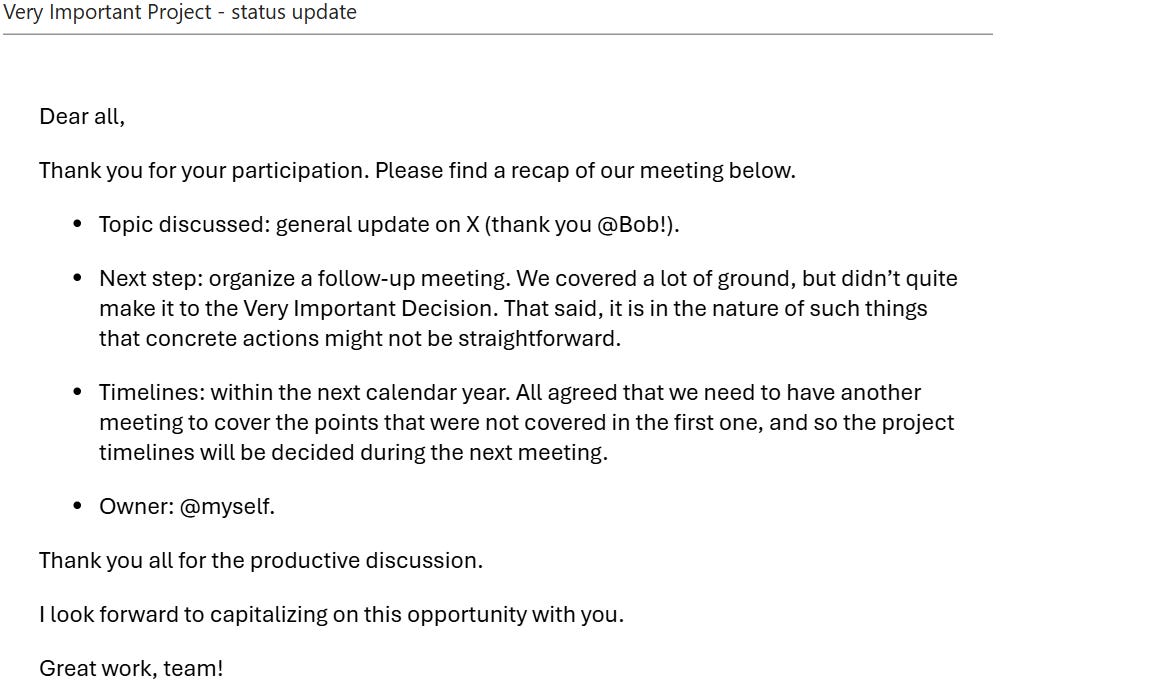
Below is the email he wrote, as it was forwarded to me by one of the 44 participants (the priest):
So we beat on, boats against the current, borne forward ceaselessly into the next meeting ~ F. Scott Fitzgerald, unpublished manuscript.
The Employee in the story is you, for you have made each of these mistakes at least once.
Even worse, at times you consciously acted this way, to ensure the appearance of busyness and to avoid any accountability for a decision. I know, because I did the same.
Meetings are crucial tools for collaboration and decision-making, but it is very easy to abuse them.
Don’t do it.
If you want to run an effective meeting, follow the brief instructions from the Manager’s Digest; if in doubt, just think of what our Employee would have done and do the opposite.
Thanks for reading,
Luca
If someone in your network would find this useful, forward it their way - it costs you little and might just make their Monday morning slightly less painful.

the 44-person invite list is funny but it's also the most accurate part. I've literally seen teams where the meeting was the only place decisions could happen because nobody had explicit authority to make them anywhere else. The meeting isn't the disease, its the symptom.
Brilliant! 😀